Google Ads
 Facebook Ads
 Contact Us
 0207 164 6425
Social Proof Examples To Increase Your Conversion Rate
Reading time: Reading Time: 8 minutes

If you own or manage a website and you want to find a tried and tested technique to increase your conversion rate, then this blog post is for you. This guide is going to discuss the A to Z of Social Proof with plenty of social proof examples to hopefully inspire you.
Social Proof usually comes in the form of user generated content (content from people outside of your business) on average increased conversion rates by 161% across all industries. A pretty remarkable social proof statistic, if i do say so.
So you could say that social proof is important if you want your business to succeed online. As a CRO agency, we have seen time and time again how much of a difference this can make to a company’s bottom line.
You might think “Hey, I know what social proof is, I just throw some testimonials into my website and it works”… But you’d be wrong. Social Proof Marketing isn’t anything new, but the strategies of how it is implemented are constantly evolving.
That’s why you need to be one step ahead when it comes to get the maximum potential from it.
Let’s start by going over what social proof actually is.
Have you ever wondered why websites include reviews on their websites?
No it’s not just because everyone else is doing it.
It’s to increase trust.
The same for when you see a testimonial on a landing page. It’s more than just to look good, it’s to show the user that you are the real-deal. And in doing so, it should make them trust you more.
Showing reviews and testimonials is a part of social proof, but the strategy has several different elements that you can use on your website.
Social proof was brought into the spotlight by Dr Robert Cialdini in his bestselling book titled Influence: The Psychology of Persuasion where he explains his 6 Principles of Persuasion.
Social proof primarily relates to the consensus principle, which states the following :
“Especially when they are uncertain, people will look to the actions and behaviors of others to determine their own.”
So we can take from this that when people are thinking about buying a product or service, they will look to be reassured by other people and give them the confidence to go through with the purchase.
That’s why an average buyer will read 10 online reviews before deciding whether to buy or not. These shoppers need reassurance that they are not going to do something that they will later regret.
Social Proof is about increasing the trust level for your website visitors to motivate them to buy.
It’s important to remember that just because you have social proof doesn’t mean people will buy, things like your value proposition and pricing will play a part too.
It’s also not just about putting as much social proof on your website as you possibly can. Doing this could have the opposite effective and have a negative impact on your conversion rate.
Let’s jump in and hopefully you can find some social proof ideas for your website.
In one of the most well known Social Proof Experiments, Robert Cialdini and Noah Goldstein conducted an experiment within a hotel.
The primary objective was to encourage more guests to reuse their towels and was titled “Using Social Norms to Motivate Environmental Conservation in Hotels”.
The rooms of the hotel were divided with two different messages. One half of the guests were given the following message without any social proof:
“HELP SAVE THE ENVIRONMENT. You can show your respect for nature and help save the environment by reusing your towels during your stay.”
The other half of the guests were shown a message which included social proof :
“JOIN YOUR FELLOW GUESTS IN HELPING TO SAVE THE ENVIRONMENT. Almost 75% of guests who are asked to participate in our new resource savings program do help by using their towels more than once. You can join your fellow guests in this program to help save the environment by reusing your towels during your stay.”
The people that saw the first message recycled their towels 35.1% of the time but the people which saw the message that included social proof, recycled their towels 44.1% of the time!
Which is a big impact with 22.5% more people recycling their towels when seeing a message containing social proof.
Now we’re going to jump into some real life social proof examples that you can use on your website to increase your conversion rate.
It’s only right that we start with the most frequently used social proof element that’s included on a website. The famous Testimonial. They’re not something to be shied away from either, testimonials have been found to increase conversions by as much as 34% on sales pages.
Our first example is from Hotjar. They have created a page that is entirely focused on testimonials from well-known companies that use their product.
On the page they include video interviews of representatives from the company to explain why they like the product so much and why they get so much value from it.

Key Points To Remember :
Awards are a great way to show users that you are good at what you do.
And this is taken home in our next example from LV. On the website they are stating that they were “Insurance Provider of the Year 2019”.
Pretty good for a company that’s selling insurance to tell their prospective buyers that they are the provider of the year from a credible source.

Key Points To Remember :
A whopping 97% of buyers have said that online reviews impact their purchasing decisions.
That’s basically like saying anyone that’s interested in potentially buying something, will be influenced by reviews.
On top of that, 57% of consumers will only buy or use a business service if it has at least a 4-star rating. So it’s not only important to have reviews, but it’s also important that they have a rating of at least 4 or more.
Here’s an example of 3rd party reviews being used by Swim Now. As you will be able to see they are using two 3rd party reviews from the same company. One which is shown below their CTA and one on the left hand side that is visible at all times when a user scrolls down the page.

Key Points To Remember :
Next on our examples of social proof are customer reviews.
Did you know that buyers are willing to spend 31% more on a business with excellent reviews?
Customer reviews are another great example of social proof. Usually seen on ecommerce stores, it will display reviews for specific products that are for sale on a website.
The main difference here from reviews by 3rd parties is that they are collected internally by the company selling the products. So there’s no verification that these reviews are genuine or not.
Here’s an example from Wiggle which shows a star rating as well as the text from the reviews further down the page.

Key points to remember :
Case studies are a way for businesses that offer an insight into their performance in a more in-depth level. This would typically be used by companies that offer a service that’s performance based.
The case study would usually go into detail about results that they have achieved and the details of how they did it.
The example you can see below is taken from our own PPC agency page.

Key Points :
Next up we have social proof counters. These usually come in the form of a numerical value related to a data point.
For instance “We’ve sold over 3,000 hotdogs in the past week”.
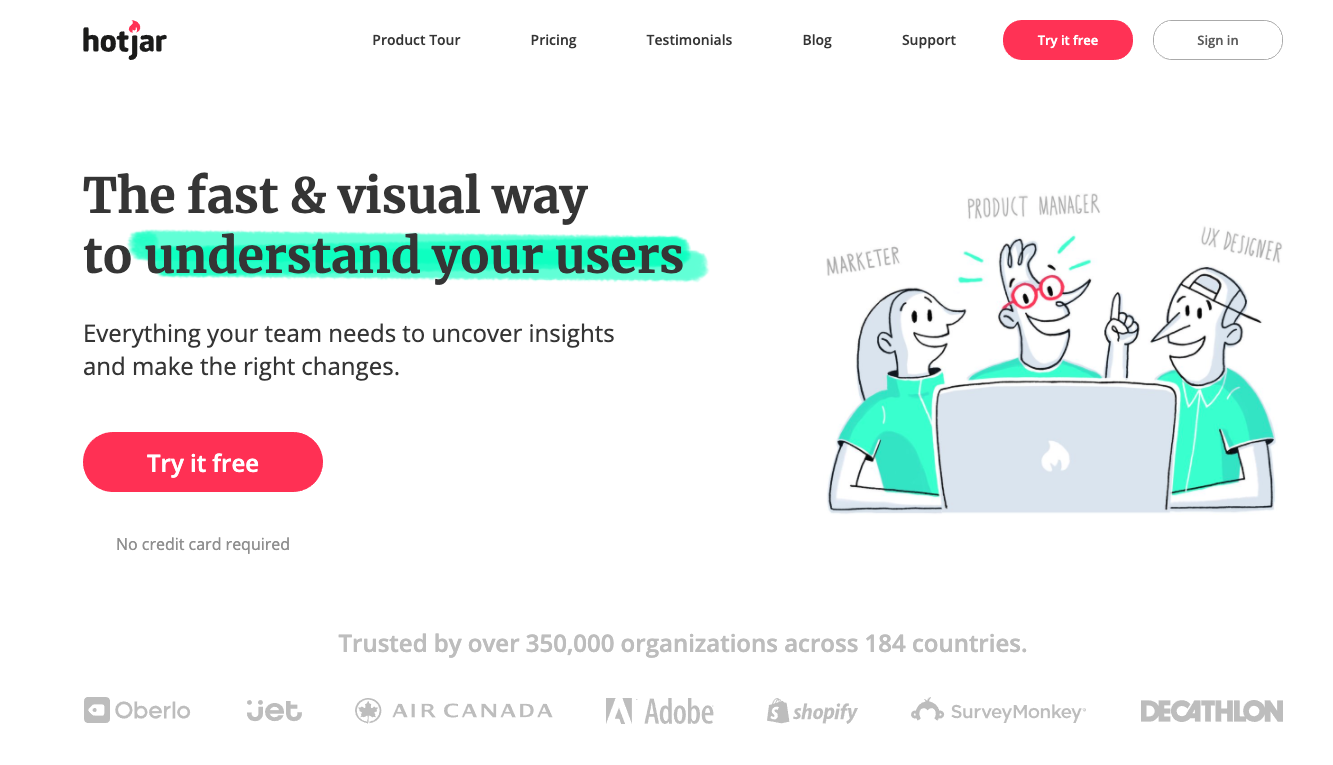
The example we have for you from the real-world is from the guys over at Hotjar again. As you will be able to see they are using two forms of counters.
The first is “Trusted by over 350,000 organizations” and the second is “ across 184 countries”. Albeit the total countries may have less of an impact, it still demonstrates the scale of their product when paired with the total number of companies using it.
Key Points To Remember :
Ever wondered why you bought that tennis racquet that had a picture of Roger Federer holding it? Well more than likely you were influenced to buy it due to his celebrity status.
Well-known people can be used as social proof to influence a buying decision. These well-known people don’t have to be celebrities either, they can simply be well-known in their industry.
Here’s an example from Ahrefs. Here you can see 3 well known people from the SEO industry that are singing their praises for their software.
The reason this works is because of their status. People respect them and know them for being knowledgeable in their industry.

Key Points To Remember :
In our penultimate example, we have a great example of social proof from GoCompare that has been implemented using statistics from their reviews.
Just showing their star rating is pretty straightforward, but by also including a count of how many reviews they have received adds another layer to their credibility.

Finally we have Social Proof Tools. These tools are starting to be seen more frequently on websites. What they typically indicate is how many users have completed a certain event over a time period.
Here’s some examples :
A real life example can be seen here by Nudgify. They are the makers of the tool which allows websites to display this data to visitors on their website.

Key Points To Remember :
I really hope you have found this guide to social proof examples helpful and the importance of social proofing your website. It’s now up to you to decide which ones to implement based on what’s relevant to your business.
We would always recommend split testing different types and ways of implementing them to find out which ones are most effective towards increasing your conversion rates.
If you have any questions or comments, feel free to drop a note into the comments below.